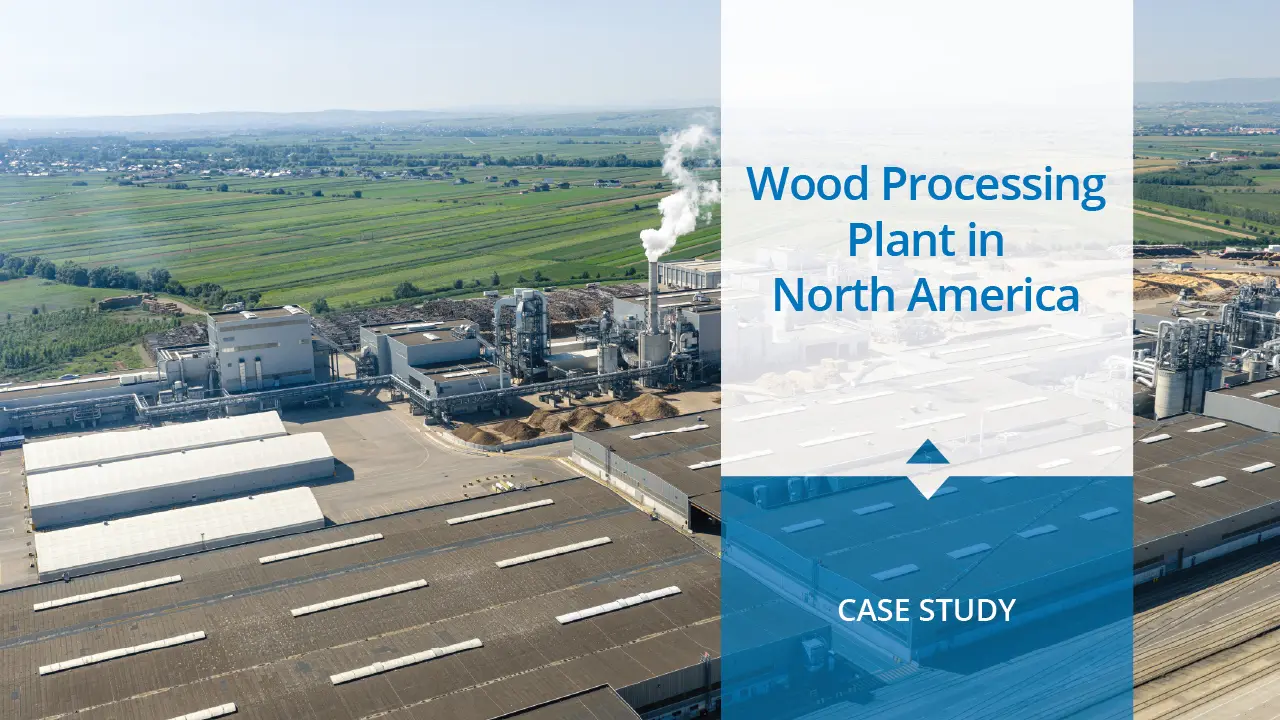
Reducing capital costs, accelerating deployment, and strengthening security using Cogent DataHub software.
Management at a major North American wood processing company implemented a plant-wide data collection and integration architecture using Cogent DataHub to reduce production costs, accelerate digital infrastructure deployment, and strengthen cyber and operational resilience — without adding new infrastructure platforms or increasing cybersecurity risk.
Key Outcomes and Economic Impact:
- Lower Capital Investment and Faster Time-to-Value
- Implemented a modern, scalable data infrastructure using a single software platform (Cogent DataHub) instead of multiple brokers, gateways, and custom integration layers.
- Avoided additional capital purchases for separate MQTT brokers, protocol gateways, and edge aggregation tools.
- Architecture was operational in the first week, validated within weeks, and fully in production within one month — dramatically reducing engineering hours and project risk.
- Security and Operational Risk Reduction Without New Cybersecurity Attack Surfaces
- Achieved OT–IT–Cloud integration through segmented networks and DMZ architecture without opening inbound firewall ports.
- Maintained closed firewall posture using outbound-only connection patterns and DHTP (DataHub Transfer Protocol) transport.
- Implemented redundancy and data continuity via automatic and real time switching between data streams.
- Faster Enablement of Production Analytics and Efficiency Gains
- Rapidly enabled real-time and historical analytics across MES, historian, and cloud platforms.
- Unified namespace and consolidated data streams reduced data preparation overhead and improved analytics readiness.
- Enabled earlier identification of process inefficiencies and production optimization opportunities.
Project Overview:
As part of a digital transformation initiative, plant engineers were tasked with securely moving plant-floor data to IT systems and cloud services for real-time and predictive analytics. Requirements included:
- Handling redundant MQTT data sources
- Integrating MES and plant historian data
- Enabling edge processing and consolidation
- Secure OT-to-IT data transfer across segmented networks
- Cloud distribution to IoT and Azure data lake platforms
Technical Architecture:
The initial requirement was to connect redundant MQTT data streams and deliver them to on-site MES and plant historian systems, while also consolidating and preparing the data for secure transfer to IT and cloud environments.
Two redundant MQTT streams were connected outbound through the firewall to a DataHub Smart MQTT Broker running on an intermediate system. The Smart Broker resolves and merges these redundant feeds into a single consistent data set. At the same time, it integrates the MES, historian, and MQTT data into a unified namespace.
Instead of deploying multiple middleware components, protocol converters, and brokers, the DataHub platform performed:
- MQTT smart brokering
- Redundancy resolution
- Data aggregation into a unified namespace
- Edge processing
- Secure transport bridging
This consolidation of functionality reduced both software sprawl and infrastructure complexity.

Secure OT–IT Data Movement via DMZ:
Data then flowed through a second firewall using DHTP (DataHub Transport Protocol) into the IT network. To maintain strict security controls:
- Connections were initiated outbound from the IT/admin network
- No inbound firewall ports were opened
- The intermediate node functioned as a DMZ isolation layer
- Bidirectional data flow was enabled only after secure outbound session establishment
At the IT level, data was logged into an ODBC-compatible database where real-time analytics were performed — enabling faster operational insight without exposing OT systems.
This architecture delivered both cybersecurity hardening and operational continuity, while avoiding the cost and risk of adding externally reachable brokers or APIs.
Cloud and Analytics Integration:
In the final stage, processed and analytics-enriched data was converted to MQTT and sent to a third-party IoT platform, as well as an Azure data lake. Because MQTT connections were established outbound, firewall rules remained restrictive, preserving security posture while enabling cloud analytics and predictive modeling.
Results:
According to a company spokesperson:
“We are pleased with how quickly this was implemented and how completely it met our requirements. Using a single platform to consolidate, secure, and distribute our data significantly reduced both project cost and deployment time. We could not have achieved this level of integration and security with a standard MQTT broker alone.”
Business and Technical Value Summary:
By standardizing on Cogent DataHub as the industrial data backbone, the plant achieved:
- Reduced capital and software stack costs
- Faster deployment and faster ROI
- Lower engineering and integration effort
- Maintained network segmentation and closed-firewall security posture
- Built-in redundancy and data continuity
- Rapid enablement of cross-system analytics
- A scalable, future-ready OT–IT–Cloud data architecture
The result was not just a successful technical integration — but a faster, lower-risk, and more cost-effective path to operational intelligence and production efficiency.