Real-Time Manufacturing Trends
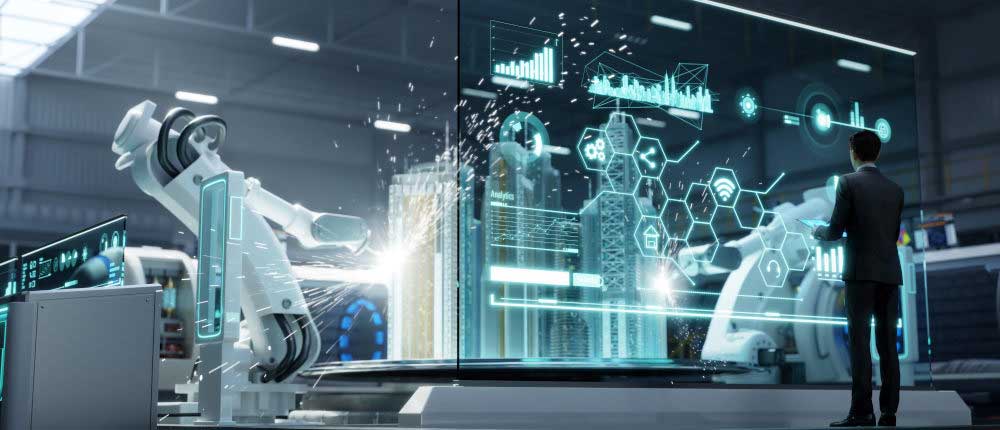
The world of industrial automation is changing rapidly, generating a need for real-time manufacturing. Most industrialized nations are seeing their economies shift from labor-rich to labor-scarce, forcing plants to automate to keep costs down. At the same time, consumers are demanding more customized products and sustainable use of resources, which requires smarter and more versatile production lines. Adding to the challenge, obtaining raw materials and parts has become less predictable since the start of the pandemic, creating a need for more dynamic and flexible supply chains.
Responding to these circumstances, executives and managers are increasingly adopting new ways of managing their businesses, according to Bill Lydon at Automation.com. In a recent report, The Digitalization Dozen, he wrote: “The foundations of manufacturing and production are being reshaped by their integration into a comprehensive real-time business system, creating more efficient and responsive production to increase sales and profits.”
Real-time data
Real-time business systems rely on real-time data. ERP (Enterprise Resource Planning) systems of the past were not directly synchronized with operations, providing data that was weeks or months old. That led to the use of MES (Manufacturing Execution Systems) which are quicker, but add a layer of cost, complexity, and fragility. What is needed, according to Lydon, is to rebuild the enterprise as a real-time manufacturing business.
A few pioneering companies have read the writing on the wall, and are now looking at ways to implement the necessary changes. Melanie Kalmar, spokesperson for Dow Corporation said, “We are really focused on being a real-time company, using and leveraging the data we have to drive better decisions, be a more sustainable company, and a favored company.”
Many others will follow, says Lydon. He explains how digital communication in real time unifies the corporate vision by providing accurate and timely data for interested parties throughout the enterprise, as well as among suppliers and customers. This data transparency keeps employees at all levels well informed, improving their decisions, which leads in turn to greater success.
Closed-loop operations
Lydon envisions a digital manufacturing architecture that is real-time, synchronized, and optimized through the use of “closed loop operations of IT and Operational Technology OT groups.” By this he means that data coming from sensors and field equipment, edge devices, plant or process operations gets passed in real time to business systems like digital twin models and analytical tools, including artificial intelligence engines. These systems pass commands back to the OT systems in a closed loop, all in real time.
Needless to say, this must all be based on secure, bidirectional real-time data communications. Security is essential because plant and operations networks must be kept isolated, completely separate from business networks. And robust, bidirectional real-time communication is necessary for closed-loop performance. Otherwise it would be like driving a car with a three-second lag between the steering wheel, brake pedal, and tires―a recipe for disaster.
Other trends
Two other trends in industrial automation are helping make real-time manufacturing work. The first is wide-spread use of open standards like TCP and OPC (Open Process Communication). Open data communication standards like these give multiple vendors a chance to compete and contribute, which brings new ideas and more product choices for system designers and integrators. Industrial systems are complex, with a wide variety of sensors, devices, tools, machines, and other components that need to be connected seamlessly. Standard protocols make these connections possible.
A second trend is towards less programming, by using off-the-shelf software and services. These make it easier, faster, and cheaper for a system integrator to test, build, and deliver a working automation system. A generation of engineers who had to build solutions from scratch is retiring, just as systems are growing more complex. The new generation understands the value of using ready-made tools to quickly implement solutions, rather than starting from the ground up on each new project.
From our perspective, these trends all point towards a need for products and services that provide secure, real-time industrial data communications. Our latest release, DataHub 10, runs both on-site or in the cloud, connects OT to IT securely through DMZs, and supports real-time networking of live and historical data. It is well positioned to lead the way for digital and real-time manufacturing.


